
What Is the 28-Day Bidding Window?
Before applicants can begin the E-rate competitive bidding process, they must certify an FCC Form 470. Form 470’s are used to notify potential service providers of the products and services an applicant is seeking, giving vendors an opportunity to review the request and submit bids.
After you certify your Form 470, a minimum of 28 calendar days must pass before you can select a service provider and enter into a contract.
This period allows service providers an opportunity to review the posted request and submit bids.
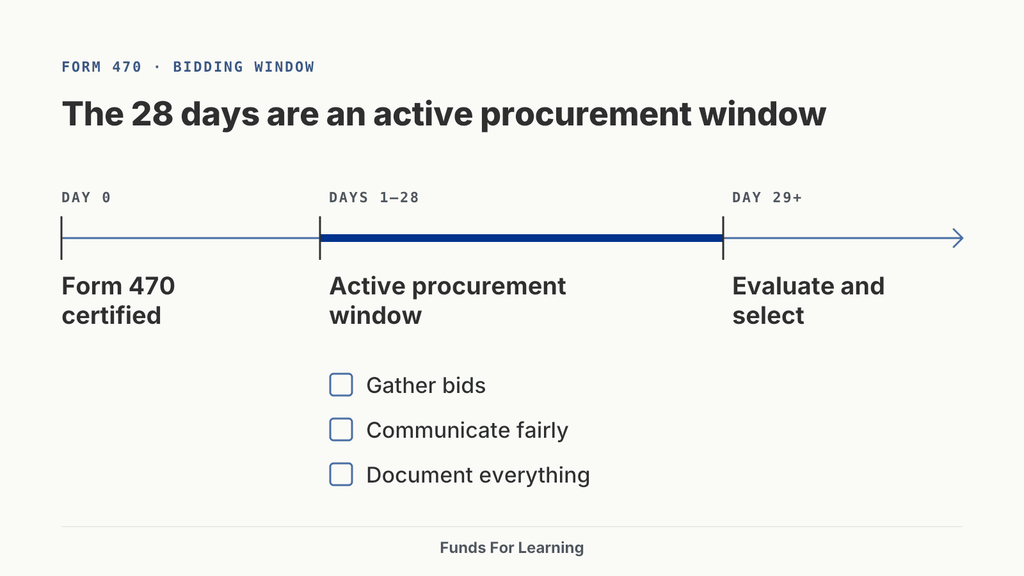
You must follow the competitive bidding requirements throughout this period. Remember, the 28-day period is a minimum waiting period, not necessarily a deadline for selecting a provider.
What Should You Be Doing During the Competitive Bidding Process?
- Monitor incoming bids and maintain records of all vendor communications, including questions, responses, and bids received.
- Make sure all interested vendors have access to the same information and receive consistent responses to questions.
- Review incoming bids to identify any questions or clarifications that may be needed.
- Avoid making a vendor selection before the 28-day waiting period has passed.
- Document your efforts and follow the applicable competitive bidding requirements, even if no bids are received.
Vendor Outreach and Bid Evaluation Preparation
You can proactively reach out to vendors during the 28-day bidding window to encourage participation and solicit bids. You don’t have to simply wait for vendors to discover your posted Form 470.
When communicating with vendors, be careful not to provide additional information, requirements, or specifications that weren’t included in your Form 470 or associated Request for Proposals (RFP), if one exists. Any clarifications or additional information should be made available to all prospective bidders to keep the process fair and open.
If you include a bid evaluation matrix or specific evaluation criteria in your RFP, you must follow those established criteria when evaluating submitted bids. Don’t change the criteria or their weighting after you’ve posted the Form 470 in EPC.
If you didn’t include an evaluation matrix in your RFP, the bidding window is a good time to establish and document your evaluation criteria before bids start coming in.
Regardless of which evaluation criteria you choose, price of the eligible products and services must be the most heavily weighted factor. All criteria should be relevant to the requested services, clearly defined, and applied consistently to every bid.
What Happens If Something Changes During the Competitive Bidding Process?
If an applicant identifies an error or needs to make changes to the services requested, they should first determine whether the change is minor or materially affects the competitive bidding process.
For minor or insubstantial changes, applicants can generally provide clarifications or additional information without restarting the 28-day waiting period.
For material changes to the requested services, applicants can upload an addendum or updated RFP to the existing Form 470 through EPC. In these cases, the 28-day waiting period restarts from the date the addendum or updated RFP is uploaded.
Applicants should clearly communicate any amendments or addenda to prospective bidders and allow adequate time for vendors to respond. Any changes should be handled fairly and consistently to avoid giving one vendor an unfair advantage.
What Happens After the 28 Days?
Once the minimum 28-day period has passed, you can complete your bid evaluation and select a service provider.
You must use a fair and open evaluation process. Price of the eligible products and services must be the primary factor in the bid evaluation. You may consider other relevant factors, as long as they’re disclosed and applied consistently.
Retain your bid evaluation documentation, and select the most cost-effective bid under your stated criteria.
Common Mistakes to Avoid
- Selecting a vendor before the 28-day waiting period expires.
- Failing to maintain documentation of bids, vendor communications, and the bid evaluation.
- Providing information to one vendor that isn’t available to other prospective bidders.
- Making material changes to requested services without restarting the required bidding period.
- Treating the 28 days as simply a waiting period rather than an active procurement process.
The One Thing Every Applicant Should Know
The 28-day window isn’t just a mandatory waiting period; it’s an important part of the competitive bidding process. Use this time to gather bids, communicate fairly with vendors, maintain documentation, and prepare for a defensible vendor selection.
Want to go deeper on any of this? Using your procurement window to your advantage is one of the topics at our next My E-rate Guides (MEG) webinar on December 3. It’s free, it’s live, and you can bring your questions. Register here.
Related: Your FY2027 Form 470 Hasn’t Changed Much. Here’s How to Get a Head Start.
About the Author: Justin Chitty has been at Funds For Learning for about 6 months, finding fulfillment in knowing his work serving schools and libraries makes a meaningful impact in students’ education. Outside of work, he’s an avid comic book collector and enjoys golfing.