
State master contracts can make E-rate procurement easier, but they are not an automatic shortcut around competitive bidding. The key question is how the state contract was established and how you’re using it.
That distinction determines whether you can rely on the state’s procurement or must conduct your own E-rate compliant evaluation.
What You Need to Know
USAC defines a state master contract as a contract competitively bid and put in place by a state government entity for use by eligible entities.
There are two common paths.
- The State Filed the FCC Form 470
This is the cleaner scenario.
If your state filed an FCC Form 470 and conducted the procurement in accordance with FCC requirements and state procurement law, you can cite the state’s Form 470 on your FCC Form 471. USAC says you don’t need separate bidding documents or a separate contract beyond what the state master contract and applicable state and local procurement rules require. The signed contract between the state and service provider also satisfies the FCC signed-contract requirement.
There is an important wrinkle when the state awards contracts to multiple providers.
Required: If a state-filed Form 470 results in a multiple-award schedule, where more than one contracted provider can serve you, you’ll need to conduct a mini-bid (a smaller competitive comparison among just those providers) among all providers able to provide the service. Price of eligible products and services must be the most heavily weighted evaluation factor.
Not Required: In this scenario the applicant would not be required to wait the traditional 28 day bidding period. And per USAC, if only one contracted provider can serve you, you can skip the mini-bid entirely.
- You Filed Your Own FCC Form 470
Here, the state master contract doesn’t replace your own competitive bidding process.
If you post your own Form 470 and treat a state master contract as a bid, you must follow FCC competitive bidding requirements and applicable state and local procurement law. Price of eligible equipment and services must receive more weight than any other evaluation factor.
There is another detail worth watching: if you decide to consider a state master contract as a bid response, USAC says you must consider all other applicable state master contracts as bid responses too. That is different from receiving a bid from a vendor that happens to hold a state contract.
When State Master Contracts Don’t Work
A state contract cannot cure a defective applicant-run competitive bidding process.
A previous FCC decision is a useful warning. A district filed its own Forms 470 but did not provide enough quantity and capacity information for prospective bidders to formulate meaningful bids. After receiving no bids, it selected providers through a state master contract. The FCC upheld a funding denial and rescission because the underlying Form 470 did not provide sufficient information to support competitive bidding.
The practical lesson is straightforward: you can’t post an inadequate Form 470 and then rely on a state contract to fix the problem afterward.
What You Should Do
Before using a state master contract for E-rate:
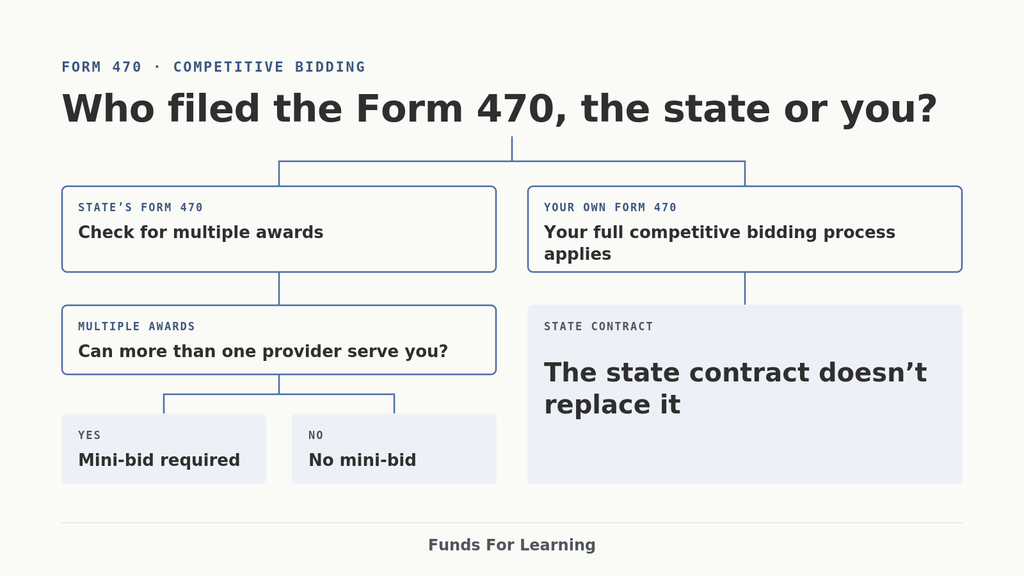
- Determine whose Form 470 established the procurement. The compliance path changes depending on whether it was the state’s Form 470 or your own.
- Check for multiple awards. If the state awarded multiple providers that can serve you, determine whether a mini-bid is required.
- Follow the contract itself. USAC specifically says you must comply with state-master-contract requirements such as required purchase orders and associated deadlines.
- If you file your own Form 470, make it specific enough for vendors to prepare responsive bids. USAC describes competitive bidding as an open and fair process, and the FCC has enforced the requirement that prospective bidders receive enough information to understand your needs.
Best Practice: Before citing a state contract on your Form 471, keep documentation showing the establishing Form 470, the applicable state contract, your mini-bid or bid evaluation if required, and compliance with any purchasing requirements in that contract.
Bottom Line
State master contracts can simplify E-rate procurement when the state has completed an E-rate-compliant competitive bidding process. But the words “state contract” alone do not eliminate your competitive bidding obligations.
Managing state master contracts is part of what our Guides do for clients every filing season. Want help with yours? Request a proposal for E-rate consulting services.
About the Author: Patrick Burke is an E-rate Guide at Funds For Learning. Based in Edmond, Oklahoma, he has guided close to 100 school districts and libraries through the E-rate program over his five years with Funds For Learning.