
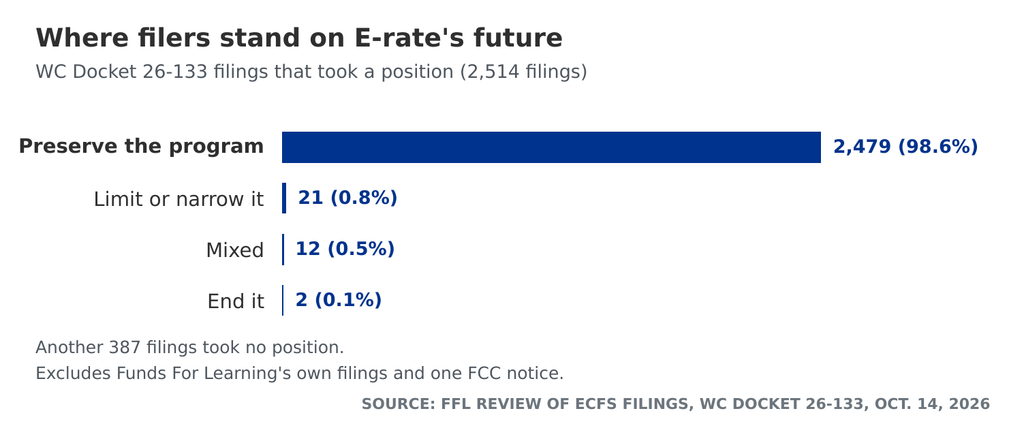
In June, the FCC asked whether E-rate’s mission is complete. Of the 2,514 filings in WC Docket 26-133 that took a position on the program’s future, 2,479 (98.6 percent) urged the Commission to preserve it. Funds For Learning reviewed the comment records in both open E-rate rulemakings. Where filers disagree, it’s over federal screen-time rules, the details of the proposed consultant rules, and the makeup of USAC’s Board.
A big record, led by schools and libraries
WC 26-133 held 3,276 filings when we pulled the record from ECFS at 5:16 p.m. ET on October 14, including 778 that arrived on October 13, the comment deadline. We coded 2,905. School districts and schools filed 1,323 of the coded filings, individuals filed 986, and libraries filed 214. Technology directors (481) and superintendents (400) were the most common writers among those who named their role, and filers came from at least 49 states and the District of Columbia.
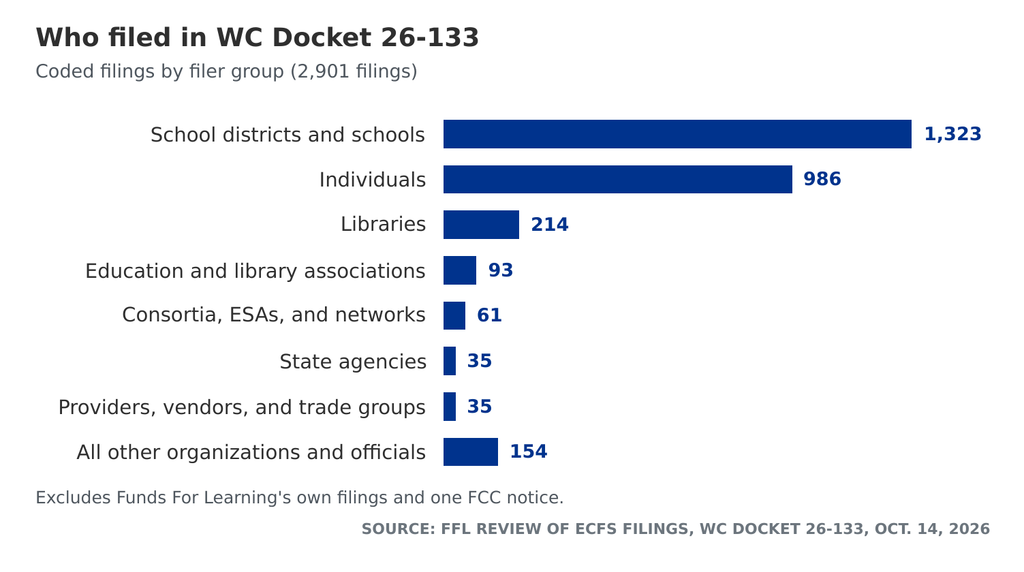
Plenty of these are form letters. At least 646 coded filings are copies of 16 letters, and the most common one appears 414 times. Most of those copies, 421 of the 646, still carry local dollar figures. In all, 1,004 filings give E-rate dollar figures for the writer’s own district, library, or organization, and 1,146 say local budgets couldn’t absorb the cost without E-rate.
Few filers asked to narrow E-rate, and only two asked to end it
Just 21 filings asked the Commission to limit or narrow the program, two asked it to end E-rate, and 12 took mixed positions. The critics who filed detailed comments mostly want a smaller program. Their proposals include phasing down discounts for the least-needy applicants, limiting special construction, reversing the presumption that activity on school and library premises serves an educational purpose, and tying funding to student outcomes.
Several critics also said the FCC can’t end E-rate on its own. The Competitive Enterprise Institute, the International Center for Law & Economics, Boston College law professor Daniel Lyons, and Harold Furchtgott-Roth of the Hudson Institute each said so or conceded the point. CEI wrote that “the Commission may narrow the program to its statutory core, but it may not narrow the program out of existence.” Former FCC Commissioner Michael O’Rielly went further in a paper the Free State Foundation attached to its comments, arguing that E-rate should be curtailed or ended if it isn’t delivering or is hurting students.
Screen time is where the record splits
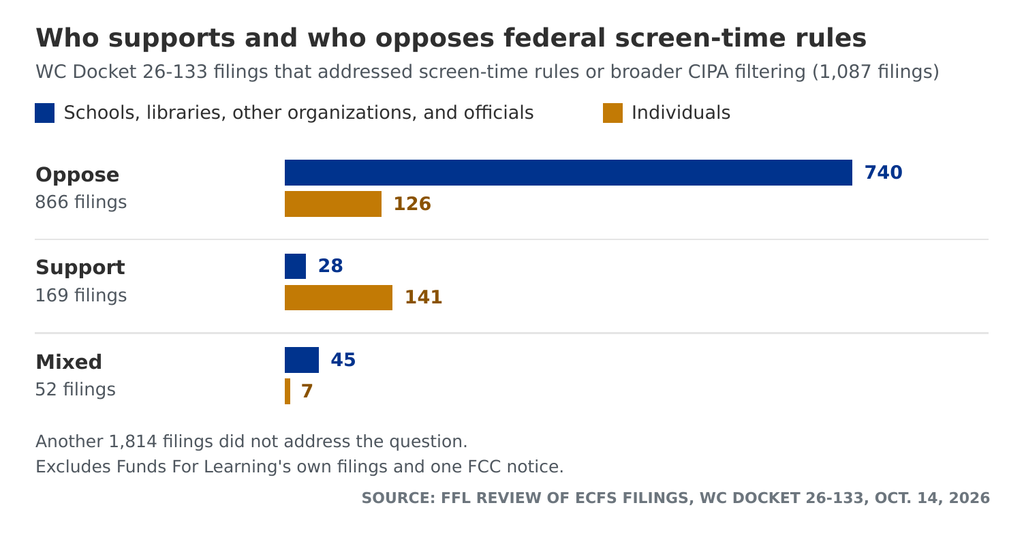
The NPRM also asked whether E-rate support should come with screen-time limits, parental opt-outs, or broader filtering. The coded filings that addressed federal screen-time rules or broader CIPA filtering ran 866 opposed, 169 in support, and 52 mixed.
Individuals filed most of the support, 141 of the 169 filings, and 56 of them identified themselves as parents. The National Telecommunications and Information Administration (NTIA) put similar concerns in the record. Its summary of a September 15 listening session reported that most testimony was critical of routine screen-based instruction, and NTIA asked the FCC to carefully consider the filings of parents, students, teachers, and child development experts. NTIA didn’t recommend a rule.
Districts, libraries, and the groups that represent them filed most of the opposition. Among the 72 major filers we reviewed in depth, 28 opposed FCC screen-time rules beyond CIPA. About half of those said the Commission lacks the authority, and the rest said the decision belongs to states and local school boards. Six major filers supported FCC action beyond CIPA, and three of them, the Ethics and Public Policy Center, Defending Education, and the Digital Progress Institute, made the legal case for it.
The consultant proposals drew support and requests for carve-outs
The FNPRM proposes to define, register, and certify E-rate consultants. Those proposals drew 95 filings in support, 30 opposed, and 52 with mixed positions. CoSN asked that any new obligations fall on consultants rather than applicants. Sixteen of the 21 major filers that addressed the definition of “consultant” asked for carve-outs or a narrower definition, such as excluding state E-rate coordinators and other public employees, volunteers, or providers’ sales channels, or covering only paid consultants. Commenters split on the proposed ban on percentage-based fees. As a firm that helps applicants with their filings, we have a stake in these rules, and our comments explain where we stand.
On October 13, Senator Ted Cruz filed a Senate Commerce Committee staff report on E-rate consultants, “The Cost of Connection,” in both dockets.
Education filers and carriers mostly agree on USAC audit recoveries
The FCC’s other open rulemaking, WC Docket 26-173, asks how USAC should administer the Universal Service Fund. Its record is far smaller, at 33 filings. Twenty-four came from 22 organizations and officials, three from individuals, two from us, and four from the FCC. USAC didn’t file, and neither did national school and education technology associations such as AASA, NSBA, CoSN, and SETDA. Many of the comments came from carriers and from participants in the Lifeline and Rural Health Care programs, and on pay-and-dispute and extrapolation most of them line up with the education filers.
Pay-and-dispute would require USF recipients to repay a recovery once the Bureau or the Commission has upheld it, even while a further appeal is pending. Eight of the nine filers that addressed it opposed it, and the ninth, WTA, would accept it only with interest-bearing refunds. Extrapolated recoveries, which estimate a total from a sample of audited items, found no unconditional support either. Of the 12 filers that addressed it, five opposed it (some speaking only for their own programs), six would accept it only with guardrails, and WTA opposed using it automatically. NTCA reported what consultants serving its members call “audit roulette,” meaning “different outcomes for the same issue depending solely on which third-party auditor was involved.”
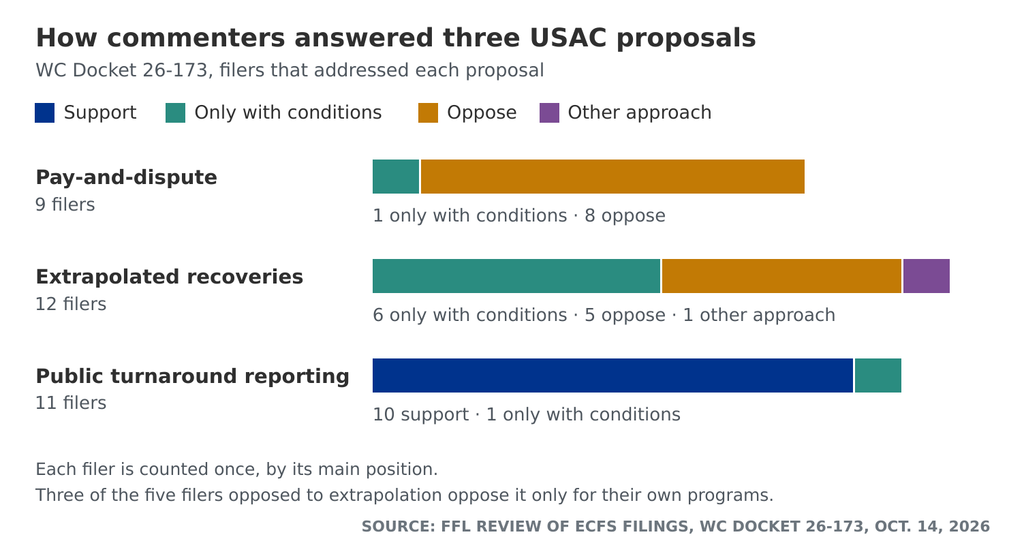
Public turnaround reporting drew wide support. Ten of the 11 filers that addressed it supported it, and SHLB and ALA, in a joint filing, and the Michigan Statewide Educational Network (MiSEN) asked for measures based on dollars, not just request counts. MiSEN reports that its final funding commitment came after September 1 in nine of the last ten funding years, and that USAC committed $14.2 million for its FY2024 statewide network upgrade on August 22, 2025, 53 days after that funding year ended. Most filers that addressed shot clocks, which are deadlines for USAC to act, supported them, but the education filers split. The Kentucky Department of Education warned that rigid clocks could put speed ahead of accuracy, SHLB and ALA preferred benchmarks, and MiSEN asked for a binding September 1 deadline.
The education filers that addressed USAC’s future want it kept as the permanent administrator, and the challenges to its role came from policy groups, litigants, and a Lifeline association. The Board is less settled. Filers disagree about who should serve on it and whether school and library seats should survive if it shrinks.
Reply comments are due October 30 and November 12
Reply comments are due October 30 in WC Docket 26-173 and November 12 in WC Docket 26-133. Replies respond to what others filed, so the sample below is a good place to start. If you file, use your own numbers. A filing that states what your district or library pays for service, and how much of that E-rate covers, gives the Commission evidence no national summary can. You can file through ECFS at fcc.gov/ecfs. Our own comments are in the record too, in WC Docket 26-133 and WC Docket 26-173.
In their own words
On the program’s future
“Treating E-Rate as a finished project is like deciding to stop maintaining a highway because it has already been built.”
“Connectivity is not a capital project that ends when the line reaches the building.”
“The Commission should use this proceeding to move the E-Rate program from presumption to proof.”
Daniel Lyons, Boston College Law School
“If E-Rate is not delivering, or worse, if it is hurting students, then it should be curtailed or ended.”
On screen time
“The overwhelming weight of testimony was critical of routine screen-based instruction and the widespread use of one-to-one devices and EdTech products in K-12 schools.”
NTIA, summarizing its September 15 listening session
“In short, E-Rate should respond to educational needs. It should not help create the demand it then subsidizes.”
“No governmental agency has the Solomonic wisdom to accurately define the difference between educational and recreational screen time use.”
“The central policy question for schools is not how long a student looks at a device, but what the student is doing, under whose supervision, and for what educational purpose.”
Council of the Great City Schools
On consultants
“Any new requirements should place obligations on consultants, not applicants.”
“The GAO’s findings on consultant influence are serious and should be addressed.”
National Education Association
On USAC (WC Docket 26-173)
“Refunds arrive too late. A refund issued years later, after the budget cycle has closed, does not undo the harm to patients, students, or library patrons.”
Ad Hoc Broadband for Rural Health Group
“Faster decisions provide limited value if they lead to an increase in invoicing denials, appeals, recovery actions, and administrative rework.”
Kentucky Department of Education
Read a sample of the record
Keep the program as it is
- SHLB Coalition (78 pages). Argues the FCC lacks authority to sunset or narrow E-rate, with a Brattle Group study of the program’s economic impact.
- EdLiNC (49 pages). The record’s main legal brief against a sunset, a carrier-only reading of the statute, and broader CIPA rules.
- SECA (40 pages). State E-rate coordinators ask the FCC to keep the program’s scope and to publish specific rule text before changing eligibility or discounts.
- American Library Association (39 pages). The library case for keeping E-rate, including why patron devices should stay on library Wi-Fi.
- Council of the Great City Schools (18 pages). Large urban districts make the case against a sunset and a rural-only program.
- New York City Department of Education (4 pages). The nation’s largest school system makes a short case for keeping both categories of service and leaving screen-time policy to districts.
Narrow it or rethink it
- Competitive Enterprise Institute (19 pages). Calls for “disciplined narrowing” within the statute and says any sunset is for Congress.
- Daniel Lyons, Boston College Law School. Asks the FCC to move E-rate “from presumption to proof” by tying future funding to evidence of educational benefit.
- Free State Foundation (19 pages). Attaches papers by former Commissioner Michael O’Rielly and Daniel Lyons that call for a hard look at the program.
- Harold Furchtgott-Roth, Hudson Institute (7 pages). The legal theory that would limit support to discounts from eligible telecommunications carriers.
Screen time and CIPA
- NTIA (10 pages). A summary of parent, teacher, student, and expert testimony from its September 15 listening session.
- Ethics and Public Policy Center (23 pages). The case for screen-time limits, network-level filtering, and parental opt-outs as conditions of E-rate support.
- ACLU (13 pages). Why CIPA’s terms can’t reach screen time, and why CIPA monitoring doesn’t require pervasive surveillance of students.
Consultant rules
- CoSN (15 pages). Asks that any consultant requirements fall on consultants, not applicants, and that cybersecurity become eligible.
USAC administration (WC Docket 26-173)
- SHLB Coalition and ALA (43 pages). A joint filing that asks the FCC to keep USAC, reject pay-and-dispute and a budget cap, and report progress by funding processed.
- NTCA (22 pages). Audit reform from rural carriers, including audit deadlines, published appeal decisions, and advisory opinions.
- MiSEN (15 pages). Michigan’s statewide network reports that its final commitment came after September 1 in nine of the last ten years and asks for a binding September 1 deadline.
- Center for American Rights (7 pages). Proposes a cap on USAC’s budget, a phased move of fund administration into the FCC, and a smaller Board.
How we reviewed the record
We pulled every filing in WC Docket 26-133 from ECFS as of 5:16 p.m. ET on October 14, 2026, and every filing in WC Docket 26-173 through the same date. We coded 2,905 of the WC 26-133 filings, with AI-assisted review, for who filed and where each stands on the program’s future, federal screen-time rules, and the consultant proposals. We also reviewed the comment bodies of 74 major filings in full. They come from 72 filers, mostly national and state organizations, providers, policy groups, and government bodies, whose comments are the most likely to shape the order. We reviewed every non-FCC filing in WC 26-173 the same way, apart from one image-only exhibit.
Counts are ECFS submissions. Some filers submitted more than once, and many filings are form letters. Apart from the record totals (3,276, 778, and 2,905 in WC 26-133 and 33 in WC 26-173), our own filings are left out of the counts. We counted, but didn’t code, 367 filings in which two advocates submitted research on radiofrequency exposure, and we set aside four FCC documents. The 209 filings with no searchable text, mostly scanned images, count as taking no position, although all 40 in a random sample of them urged the Commission to preserve E-rate. A further 326 responses to the NPRM were filed only in the companion dockets (WC 13-184, 21-93, and 21-455), and 303 of them urged preservation. They aren’t in the counts above.