
In the first year applicants had to pick their invoicing method up front, more than 11,500 requests, representing $491 million in commitments, chose to pay their providers and seek reimbursement directly.
E-rate applicants have two ways to receive their discounts. Under the Service Provider Invoice (SPI) method, the provider bills the applicant only for the non-discounted share and invoices USAC for the rest. Under the Billed Entity Applicant Reimbursement (BEAR) method, the applicant pays the provider in full, then files for reimbursement of the discount, and USAC pays the applicant directly.
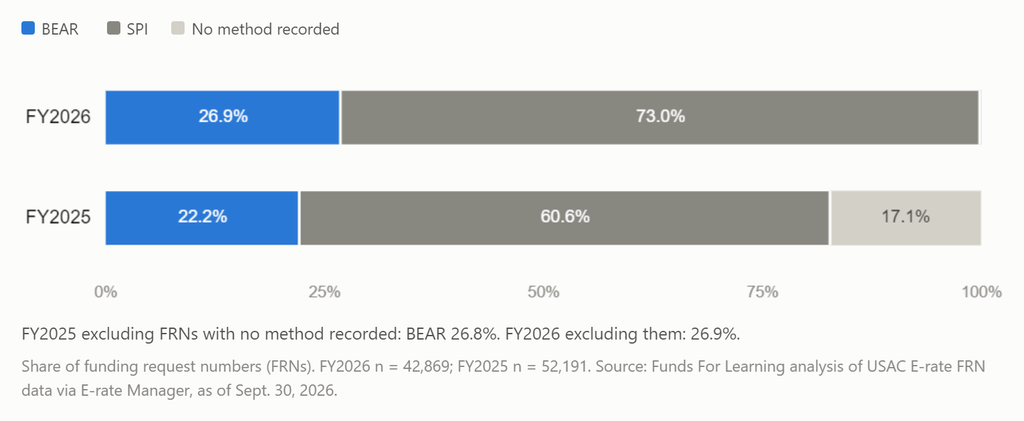
BEAR is sometimes described as a fallback or a technicality. The data says otherwise. Funding Year 2026 is the first year applicants were required to select an invoicing method on the FCC Form 471, before any service began or any invoice was filed. That makes it the clearest look yet at what applicants choose when they decide up front.
The FY2026 Numbers
In FY2026, the first year applicants were required to select an invoicing method on the FCC Form 471, applicants chose BEAR on 26.9% of funding requests (11,526 of 42,869 FRNs), representing $491.2 million in committed funding. Applicants chose BEAR on 25.1% of Category One FRNs and 29.8% of Category Two FRNs, and in 53 of 56 states and territories. FY2025 data are consistent: among FRNs where a method has been set, BEAR accounts for 26.8%. Before FY2026, the method was often fixed only when the first invoice was filed, so 17.1% of FY2025 FRNs have no method yet.
Both Categories Rely on It
Most BEAR requests are for Category One services: 58% of FY2026 BEAR FRNs, and 63% in FY2025. In Funds For Learning’s experience, BEAR is most common for recurring Category One services such as internet access.
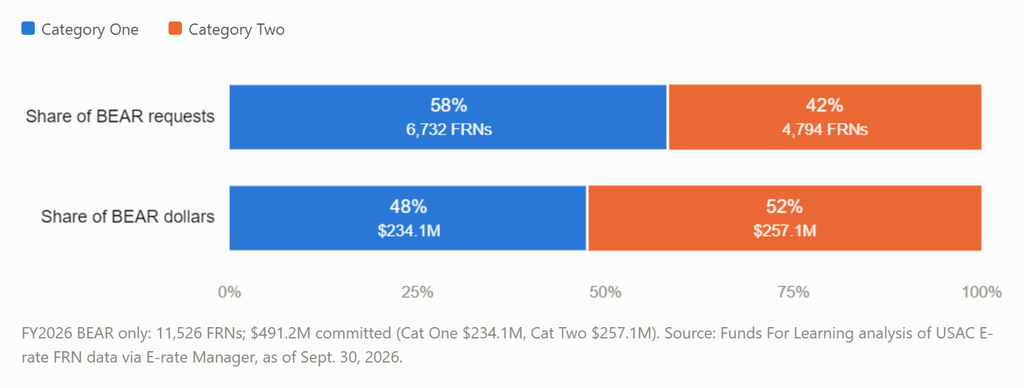
Category Two uses BEAR at a slightly higher rate. In FY2026, applicants chose BEAR on 29.8% of Category Two requests, compared with 25.1% for Category One. Category Two BEAR requests carry $257.1 million in commitments, more than half of the FY2026 BEAR total.
A National Practice
BEAR appears in 53 of 56 states and territories in FY2026. In several states, including Illinois, Maryland, Minnesota, Oregon, and Utah, BEAR is the method applicants choose most often. By dollars, the largest BEAR commitments are in New York, California, Texas, Illinois, and Michigan.
FY2025 Tells the Same Story
Before FY2026, applicants could set their invoicing method at any point, and many did not do so until they filed their first BEAR or SPI invoice, sometimes near the end of the funding year. As a result, 17.1% of FY2025 FRNs, representing $530.7 million in commitments, have no method recorded yet.
Among FY2025 requests where a method has been set, BEAR accounts for 26.8%, nearly identical to FY2026. The share held steady even as the rules for when to choose changed.
Why Applicants Choose BEAR
Paying the full bill and waiting for reimbursement is not the easy path, so applicants who choose BEAR have reasons. In Funds For Learning’s work with applicants, those reasons are practical ones: budget certainty, keeping the district in control of its funds, and the ability to put reimbursements toward other needs, including Category Two cost shares.
Timing matters too. Through FY2027, a service provider has no obligation to discount a bill until the applicant’s FCC Form 486 (the form confirming services have started) has been processed. Services often start July 1, before that happens, so many applicants pay full price for the first months of the funding year whether they chose SPI or not. BEAR is how those applicants recover the discount they have already earned. The FCC’s April 2026 order eliminates the Form 486 beginning in FY2028 and moves its certifications to the Form 471, but applicants will still depend on reimbursement for any period they pay in full.
What’s at Stake
Proposals to end direct reimbursement to applicants would remove that choice for more than a quarter of all funding requests. The Commission’s pending Notice of Proposed Rulemaking (NPRM) raises this possibility (NPRM ¶14).
About the Data
Funds For Learning analysis of USAC E-rate FRN data for funding years 2025 and 2026, accessed through E-rate Manager, as of September 30, 2026. Counts are funding request numbers, not unique applicants; one applicant may file many FRNs. Percentages use all FRNs as the base. Dollar figures are committed amounts, not disbursements. FY2026 is in progress, and commitments may change.