
The FCC Form 470 starts the E-rate competitive bidding process. It tells service providers what products and services you need and gives them an opportunity to submit bids.
A well-prepared Form 470 can help you receive competitive, responsive proposals. An incomplete or unclear filing, however, may force you to make corrections, extend the bidding period, or post a new form. Any of these outcomes can delay your contract and Form 471 application.
Here are five common Form 470 mistakes and practical ways to avoid them.
-
Waiting Until the Last Minute
You must wait at least 28 days after certifying your Form 470 before selecting a service provider, signing a contract, or filing your Form 471. The earliest date you can take these steps is called the Allowable Contract Date (ACD).
If you wait until the final Form 470 deadline (28 days before the Form 471 filing window closes), you’ll have little time to evaluate bids, obtain board approval, negotiate a contract, or prepare your Form 471. It also leaves almost no room to correct a problem.
Example: A school district posts its Form 470 28 days before the filing window closes. During the bidding period, it discovers that a major portion of the requested equipment was omitted. Correcting the request may restart the 28-day period and place the district’s Form 471 filing at risk.
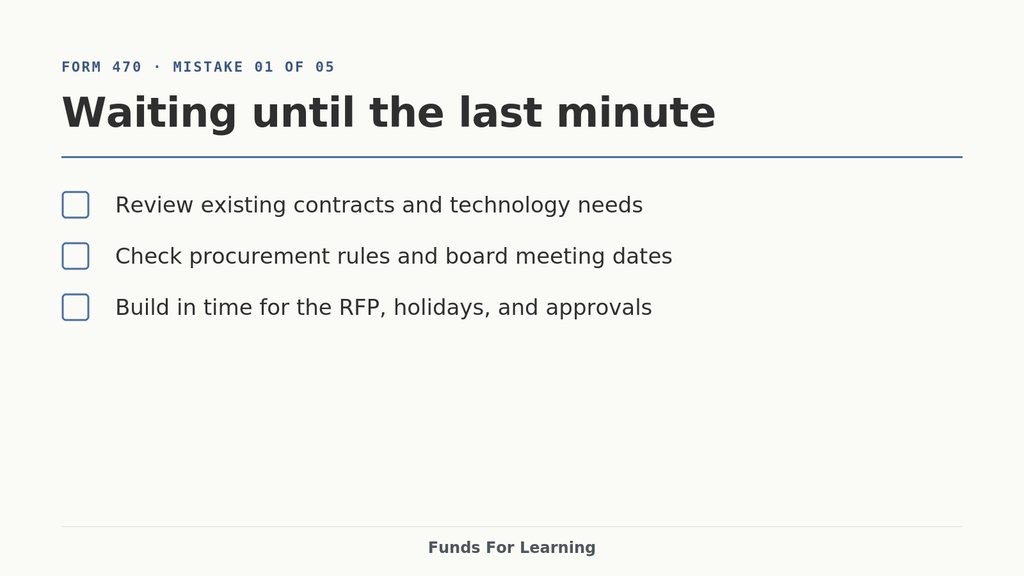
Solution: Start early. Review existing contracts, technology needs, procurement requirements, board schedules, and anticipated projects several months before the Form 471 deadline. Building extra time into the schedule allows you to address questions or corrections without jeopardizing the application. Funds For Learning recommends beginning early enough to account for RFP preparation, holidays, approvals, and unexpected delays. For more guidance, see our tips on avoiding common Form 470 mistakes, our general tips for filing the Form 470, and our advice on getting ready for the Form 470 deadline.
-
Confusing the Allowable Contract Date with the Bid Deadline
The ACD is the earliest date you may select a provider and sign a contract. It is not automatically your bid deadline.
Your bid deadline is the date you set in your Form 470 or RFP. It can’t be earlier than the ACD, but it can be later, as long as it’s clearly stated and complies with state and local procurement rules. If you don’t set a firm deadline, you must consider every bid you receive until you begin evaluating proposals.
Example: An applicant reaches its Allowable Contract Date on February 1 but does not publish a bid deadline. It receives another proposal on February 3 and rejects it solely because it arrived after the Allowable Contract Date, even though evaluation didn’t begin until February 5. Because no deadline was published, the applicant should have considered that bid. Rejecting it could be viewed as a competitive bidding violation and put funding at risk.
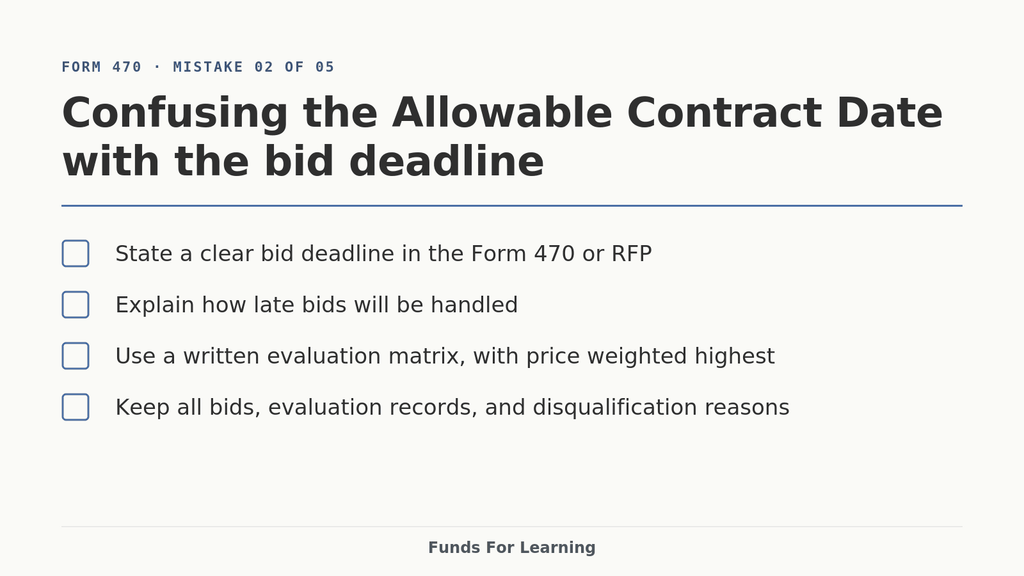
Solution: State a clear bid deadline in the Form 470 narrative or RFP. Explain how late bids will be handled and document when the evaluation begins. Once the deadline passes, use a written evaluation matrix, and remember that the price of eligible products and services must receive more weight than any other single factor. Retain all bids, evaluation records, correspondence, and the explanation for any disqualifications.
-
Using a Vague Service Description
Service providers need to be able to tell what you want from the information in your Form 470 and its attachments. A description such as “internet service” or “network equipment” may not provide enough detail for a provider to prepare a meaningful bid.
Your description should identify the type and quantity of products or services you’re requesting. For internet service, this may include the locations, minimum and maximum bandwidth, desired term, and installation requirements. For Category Two equipment, it may include quantities, technical specifications, necessary licenses, installation, and configuration.
Example: A library requests “internet access” but does not provide the service address or desired bandwidth. One provider proposes 500 Mbps, while another proposes 10 Gbps. The bids cannot be compared fairly because the providers responded to different interpretations of the request.
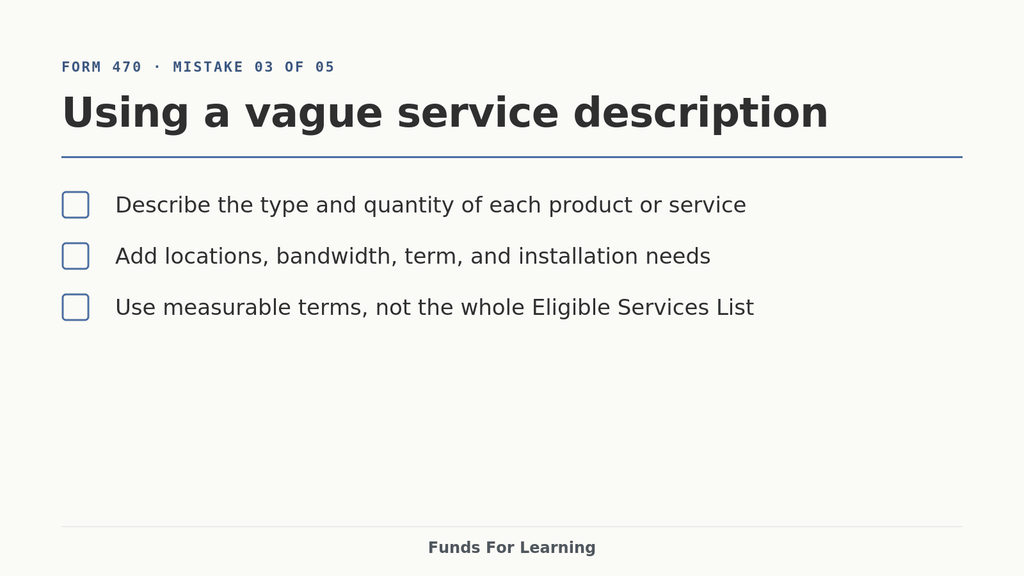
Solution: Use objective and measurable descriptions. Give bidders enough information to understand the project and submit comparable proposals. Avoid descriptions that are so broad that they resemble the entire Eligible Services List. The goal is a clear, needs-based request, not a list of every service that might be eligible. Our guide to what’s changed for FY2027 walks through this in more detail.
-
Forgetting an RFP or Supporting Document
An RFP (Request for Proposal) is not required for every E-rate procurement, although state or local procurement rules may require one. If you do issue an RFP, you must upload it with your Form 470.
Keep in mind that USAC uses “RFP” more broadly than most procurement professionals do. On the Form 470, it means any bidding document you attach, such as specifications, site lists, quantities, or bidder instructions. If a document contains information bidders need to respond, upload it.
Example: A district’s Form 470 states, “See attached RFP for equipment quantities and specifications,” but the RFP is not uploaded. Providers cannot determine what to bid, and the applicant may need to add the missing document and observe a new waiting period.
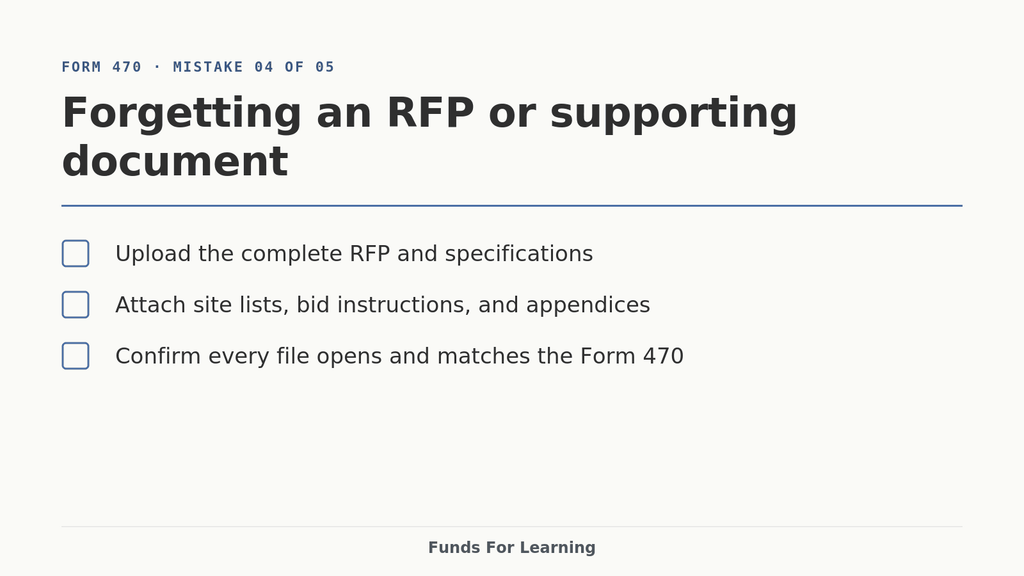
Solution: Before you certify, confirm that every referenced document is attached and readable. This may include:
- The complete RFP
- Equipment or service specifications
- Site lists
- Bid-submission instructions
- Question and answer procedures
- Evaluation or disqualification requirements
- Applicable appendices and exhibits
Also verify that your Form 470 and every attached document are consistent with each other. Conflicting quantities, deadlines, or technical requirements can create confusion and lead to bids that do not meet your needs.
-
Making a Major Change After Posting
You may sometimes discover after certification that you need to change the scope of your procurement. Minor clarifications may not affect the original timeline, but substantive changes can restart the 28-day waiting period.
Since Funding Year 2025, the E-rate Productivity Center (EPC) recalculates the 28-day waiting period when you attach a new RFP document containing a substantive correction. The new Allowable Contract Date is based on the updated posting.
Example: An applicant initially requests 25 wireless access points. After posting the Form 470, it expands the project to 100 access points, switches, licenses, installation, and three additional locations. That is more than a clarification because it materially changes the opportunity available to bidders.
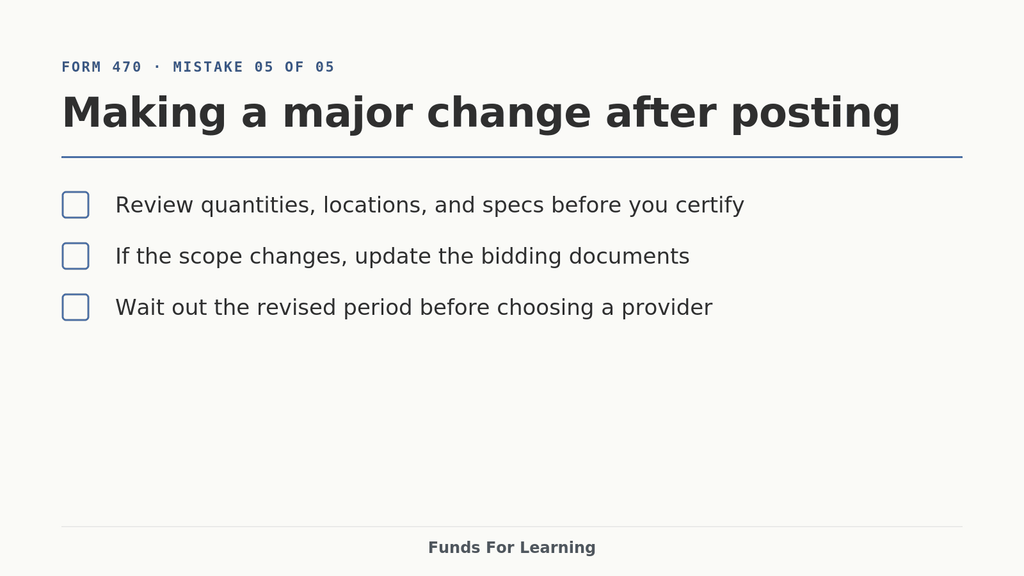
Solution: Complete an internal review before certification. Confirm quantities, locations, service categories, technical specifications, and installation needs. If a change is necessary afterward, determine whether it could affect pricing, vendor participation, or the proposed solution. If so, update the bidding documents and follow the revised waiting period before selecting a provider.
All prospective bidders should receive the same information. Questions, answers, and amendments should be handled consistently so that the procurement remains fair and open.
The Bottom Line
Most Form 470 delays can be avoided with early planning and careful review. Before certifying, make sure the request accurately describes your needs, includes every required bidding document, and clearly communicates the timeline and proposal requirements.
Starting early gives you time to answer vendor questions, correct mistakes, evaluate bids, obtain approvals, and negotiate a contract before filing the Form 471. A few extra days spent reviewing the Form 470 can prevent weeks of delays later.
Not sure if your Form 470 gives bidders enough to work with? Schedule a consultation today to talk more about how we can help.
About the Author: Chris is a Guide at Funds For Learning, helping schools and libraries navigate the E-rate process. Before joining Funds For Learning, he tutored in Seattle and taught English in Japan for five years. “What drew me to this work is being part of what allows a student in America to access the internet without worrying about cost preventing an equal share in the richness of online education.”